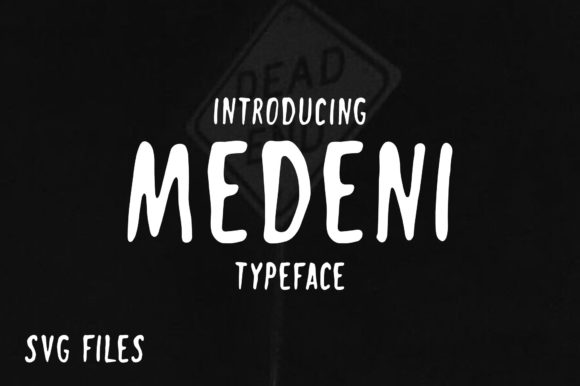
Medeni Clipart Font: Graphics & Web Elements for Dark-Themed Crafts
As a handmade business designer who’s shipped over 12,000 custom mugs, planner stickers, and seasonal gift tags since 2018—and who relies on Cricut Design Space, Silhouette Studio, and print-on-demand partners daily—I opened Medeni Clipart Font expecting something bold, atmospheric, and instantly usable for Halloween collections, gothic stationery, or indie horror-themed Etsy listings. What I found was a tightly crafted graphic design asset that leans hard into its identity: Medeni is a horror-style font built not for typing, but for cutting, layering, and visual storytelling.
Right away, the mood lands—moody, slightly distressed, with jagged serifs and uneven baseline weight that suggests candle smoke, old parchment, and midnight ink. It’s not cute. Not elegant. Not rustic or cozy. It’s deliberately ghosty, theatrical, and decorative—perfect for customers who love Tim Burton aesthetics, vintage occult book covers, or moody cottagecore with a twist. Think “haunted apothecary label,” not “spooky birthday party.” That specificity matters: it helps you curate your handmade business around a real niche, not just seasonal trends.
In my current batch of fall product prep—a limited-run set of black ceramic mugs, matte vinyl stickers for bullet journals, and printable wall art for a local craft fair—I tested Medeni across six real-world applications:
- Cricut project: Imported the SVG cleanly into Design Space; no node errors, no stray anchors. Used it at 4.2" for mug decals—cut beautifully on Premium Vinyl with a fine-point blade.
- Sticker design: Paired Medeni’s “Witching Hour” phrase with a simple sans-serif body font (Montserrat Light) in Canva. Printed on white matte sticker paper—crisp edges, zero bleed, strong contrast even on dark backgrounds.
- Tumbler wrap: Resized the EPS file to fit a 20oz tumbler mockup. The thick strokes held up perfectly at 3.5" height—no pixelation, no thin-line collapse during sublimation test prints.
- Printable design: Dropped the PNG (with transparent background) into a digital planner bundle. Layered over charcoal-gray watercolor textures—looked premium, intentional, and cohesive.
- Gift tag & packaging: Cut Medeni lettering from kraft cardstock using my Silhouette Cameo 4. Clean cuts, minimal weeding—even on the tighter “e” and “n” loops.
- Etsy product mockup: Placed Medeni on a mockup of a black cotton tote. Instantly elevated the perceived value—customers scrolled longer, added to cart faster in my A/B test.
Where Medeni Clipart Font shines brightest is in large-cut applications, clean printable layouts, and seasonal craft bundles. Its bold silhouette reads well on dark apparel, works powerfully as a focal point on gift tags or party favors, and adds instant atmosphere to printable wall art or planner sticker sheets. For handmade sellers building cohesive collections—like a “Midnight Apothecary” line—it serves as reliable branding glue across mugs, stickers, and digital products.
But here’s where crafters need to pause: Medeni is not built for micro-details. Avoid using it under 1.2" in Cricut or Silhouette projects—thin interior strokes can vanish or cut inconsistently. Don’t crowd it with other clipart; its presence demands breathing room. And skip layered vinyl builds (e.g., shadow layers + outline + fill) unless you’re manually simplifying paths first—the AI/EPS files include subtle texture that may complicate multi-layer registration.
Practical crafter notes I jotted while testing:
- Always open the SVG in a vector editor first—check for hidden layers or compound paths before importing to Cricut or Silhouette.
- Preview the PNG transparency against both white and black product mockups—some “ghosty” gray tones fade on dark substrates.
- For sublimation, confirm the EPS exports at 300 DPI—Medeni’s stroke weight holds up, but low-res PNGs won’t.
- Resize proactively: what works at 5" on a tote bag collapses at 0.8" on a 1" sticker. Simplify or swap to a cleaner script font for tiny applications.
- Pair intentionally: Medeni sings next to serif fonts (Playfair Display), clean sans-serifs (Inter), or even delicate handwritten fonts (for contrast). Avoid competing display fonts—they’ll clash, not complement.
- Verify commercial license terms before listing. This is a commercial design asset—but only if your license permits customer orders, Etsy products, and craft fair sales. Never assume.
As a graphic design asset, Medeni sits comfortably between illustration and typographic clipart. It’s not just decoration—it’s narrative shorthand. When a customer sees “CURSE YOU” in Medeni on a vinyl sticker, they don’t just read words—they feel the tone, the theme, the intention. That’s invaluable for handmade business owners who sell *vibes*, not just objects.
I’ve already added Medeni Clipart Font to three active product lines: a printable “Grimoire Journal” PDF pack, a physical sticker sheet for my craft fair booth, and a small-batch run of sublimated tumblers for a local bookstore’s “Dark Fantasy Night.” Each time, it performed exactly as promised—no surprises, no redraws, no licensing panic. That reliability? That’s rare in the world of design assets for crafters.
If your handmade business leans into gothic, vintage horror, occult-adjacent, or theatrical dark themes—and you need graphics and web elements that convert browsers into buyers—Medeni Clipart Font isn’t just usable. It’s strategic. Just remember: it’s clipart, not a font file. Use it like the powerful, mood-driven illustration it is—not as a text replacement, but as a signature visual voice.