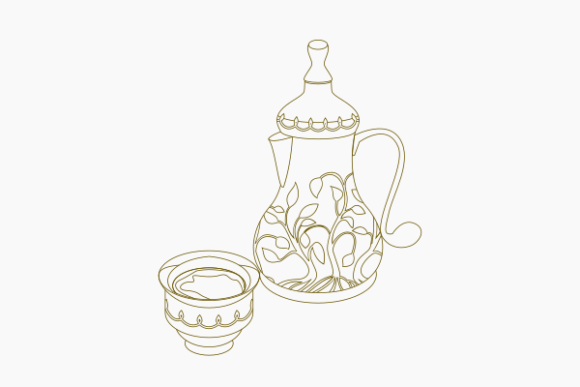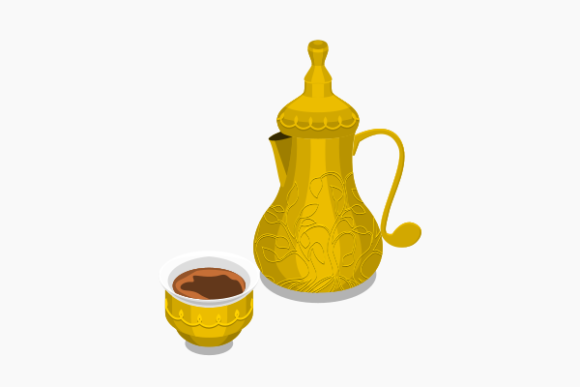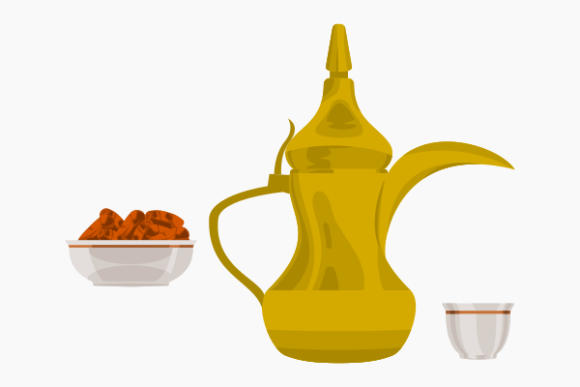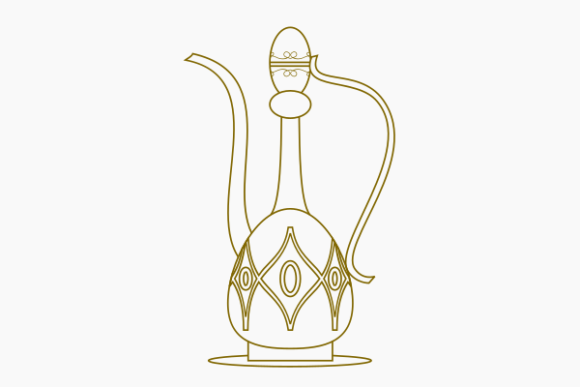
Outline Style Patterned Arab Coffee Jug
A Designer’s First Look: Clean, Cultural, and Ready for Stitching
When I opened the Outline Style Patterned Arab Coffee Jug, my first thought wasn’t “pretty”—it was “purposeful.” This isn’t a busy, ornate dallah illustration. It’s an elegant side-view silhouette with subtle patterned linework—think delicate geometric motifs tracing the spout, handle, and base, all held together by confident, flowing outlines. The mood is warm but refined: respectful of Arabian coffee culture without leaning into cliché. As a designer who regularly sources embroidery files for boutique clients and small-run apparel, I immediately pictured it stitched on a natural linen tea towel or a heavyweight cotton apron—something where simplicity reads as intention, not compromise.
Where It Shines in Real Embroidery Projects
I tested the Outline Style Patterned Arab Coffee Jug across three real-use scenarios: a custom embroidered tote bag for a local café, a set of baby onesies for a Middle Eastern family’s newborn celebration, and a limited-run patch series for an Etsy craft business. In each case, the design performed consistently well—not because it’s flashy, but because its outline style translates cleanly to thread.
- Tote bags & aprons: The clean lines hold up beautifully on textured fabrics like canvas or unbleached cotton. No fill stitch clutter means fewer thread breaks and smoother hooping—even on curved seams.
- Baby embroidery: On soft knit onesies, I used a light cutaway stabilizer and a running stitch variation. The minimal detail avoided bulk, and parents appreciated how clearly the shape read at 3 inches tall—no visual noise competing with tiny hands or sleepy faces.
- Embroidered patches: As a standalone motif, it scales down to 2.5 inches without losing identity. That’s rare for cultural symbols—many get muddy when reduced. Here, the spout and handle remain distinct, making it ideal for iron-on or sew-on patches on caps, jackets, or kitchen towels.
Where to Proceed Thoughtfully
This isn’t a “drop-in-and-stitch” file for every situation—and that’s a strength, not a flaw. Its elegance depends on context. Use caution with:
- Small hoop sizes under 4×4 inches: The jug’s proportions rely on balanced negative space. Cramping it risks flattening the graceful curve of the spout or compressing the handle’s loop.
- Stretchy or thin fabrics (like jersey or voile): Outline-only designs need crisp stabilizing. Without proper cutaway or tear-away backing, those fine lineworks can wobble or pucker—especially around the narrow neck and base.
- Dark fabric + light thread: Because it’s outline-based—not filled—the design relies on contrast. On charcoal or navy, a pale ecru or sand thread may vanish unless you add a satin stitch border or test density first.
- Curved surfaces (caps, mugs, curved pillow covers): The side-view orientation works best on flat or gently contoured areas. Avoid placing it over deep crown curves—it’ll distort the jug’s symmetry.
What It Adds to Your Finished Product—Beyond Aesthetics
The Outline Style Patterned Arab Coffee Jug quietly elevates perceived value. Customers don’t just see “a coffee pot”—they recognize craftsmanship in restraint. On a personalized gift—say, a holiday kitchen towel set—it signals attention to cultural detail without overwhelming the recipient. For Etsy sellers or small shop owners, it strengthens brand consistency when paired with complementary Arabic-inspired typography or muted earth-tone palettes. And because it’s vector-based and editable, it adapts: stretch the height for a vertical sweatshirt chest placement, simplify a section for a child’s embroidered cap, or layer it lightly behind a monogram for a wedding guest towel.
It also builds trust. Handmade product buyers scan for authenticity—not just in theme, but in execution. A clean, well-proportioned outline tells them you understand both the symbol *and* the stitch. That matters more than ornate complexity when selling on platforms like Etsy or at craft fairs.
Practical Notes Every Embroidery Designer Should Check
Before stitching your first Outline Style Patterned Arab Coffee Jug piece, do these five things:
- Test on scrap fabric first—especially if using textured weaves or blends. Watch how the line weight behaves at your chosen size.
- Review stitch density in your embroidery software. Outline-style files can sometimes generate sparse runs; add a slight overlap or double-run if needed for visibility on dark backgrounds.
- Confirm licensing terms before selling finished items commercially—or bundling it into digital embroidery kits. Since it’s labeled as an Editable SVG vector, verify whether commercial redistribution of the file itself is permitted.
- Check contrast in black-and-white mockups. If it fades on grayscale previews, it’ll likely lack punch on fabric—adjust thread color or add a subtle outline stitch.
- Use appropriate stabilizer for your fabric type. Light cutaway for knits, medium tear-away for stable wovens, and fusible + tear-away combo for lightweight linens.
Final Thought: A Quietly Confident Design Asset
The Outline Style Patterned Arab Coffee Jug won’t shout—but it doesn’t need to. In the Crafts and Graphics space, where handmade authenticity competes with algorithm-driven noise, this design earns attention through clarity and cultural respect. It’s not filler. It’s focus. Whether you’re building a cohesive line of café merchandise, creating heirloom baby items, or designing a thoughtful holiday gift, this vector gives you room to breathe—both as a maker and as a storyteller. Just remember: its power lives in precision, not padding. Respect the lines, honor the scale, and let the shape speak for itself.